Obsidian — Talisman Stone: Meaning, Properties and Who It Suits
Obsidian as a talisman stone: the origin of volcanic glass, which zodiac sign it suits, Aztec ritual use, and how to spot a fake.
Meaning and origin of the stone
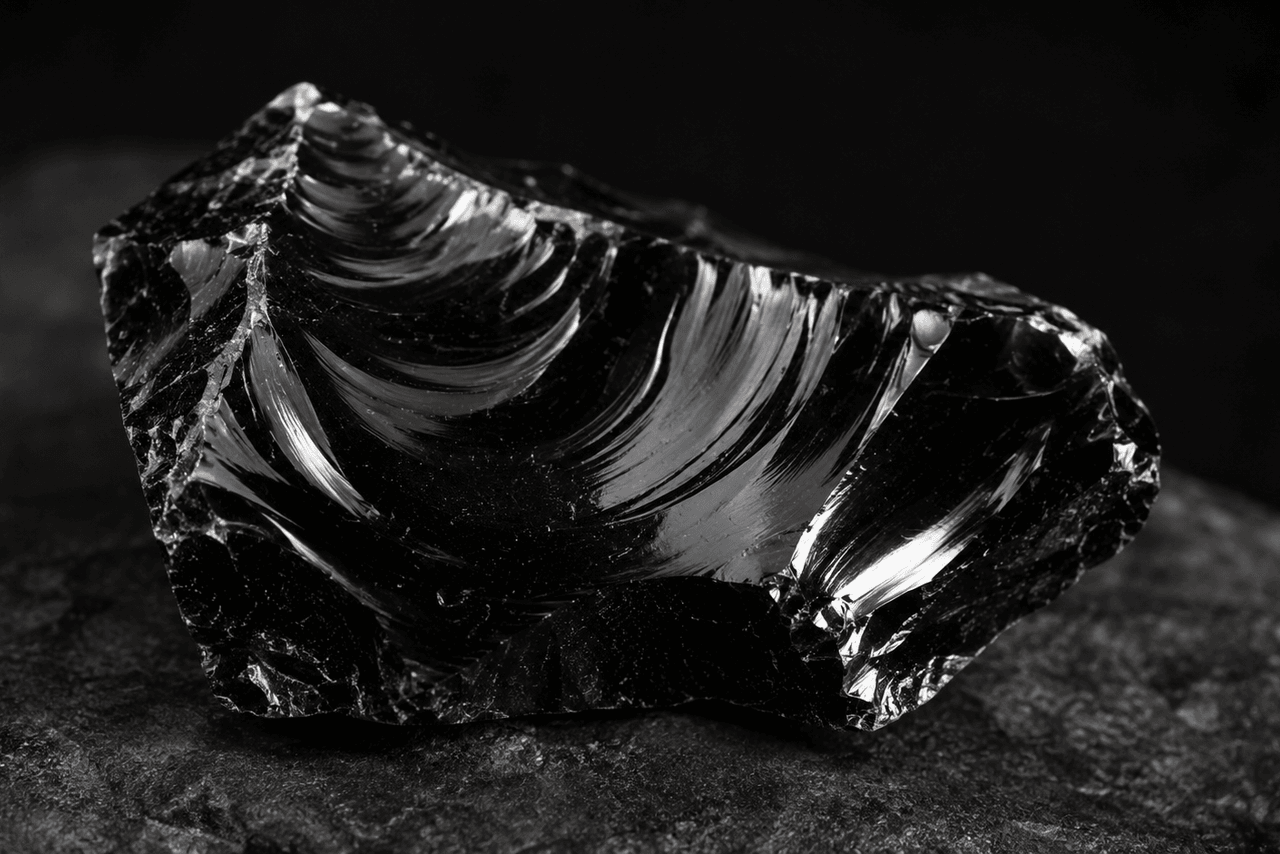
Obsidian is volcanic glass that forms when felsic lava cools extremely fast — so fast that no crystal lattice has time to form, which means obsidian, unlike most stones in this collection, isn't strictly a mineral but an amorphous glassy rock.
For the Aztecs, obsidian held a central place in culture and ritual — it was carved into the famous polished "smoking mirrors" dedicated to the god Tezcatlipoca, and into weapons of exceptional sharpness. The stone's ability to fracture into a perfectly sharp edge is still valued today: obsidian blades are used in some types of surgery because they're sharper than steel.
Which zodiac sign it suits
Obsidian is traditionally tied to Scorpio — a sign whose nature is bound up with deep inner transformation and the ability to move through crisis without being destroyed by it. The stone is said to help Scorpio look safely into its own "shadow" — suppressed fears and feelings — without the risk of drowning in them.
The stone's dark, mirror-like character resonates well with exactly that task: obsidian doesn't decorate or soften what its owner sees in themselves — it reflects it honestly, without embellishment.
Traditional and esoteric properties
Obsidian has long been credited with protecting against negative energy and absorbing it, acting as a kind of filter between its owner and outside psychological pressure. In Latin American shamanic traditions, the stone was used in cleansing rituals and practices centered on facing fear head-on.
Obsidian is also tied to the idea of honesty with oneself — it's said to help reveal the real motives behind one's actions, even when that's uncomfortable, which is exactly why it's not recommended for anyone not ready for that kind of directness in their inner dialogue.
How to spot a fake and care for the stone
Genuine obsidian shows a characteristic conchoidal fracture — chipping produces a smooth, slightly concave surface with sharp edges, much like glass. It really does resemble bottle glass closely, but it's noticeably heavier and often shows a slight color unevenness — fine gray veining or smoky streaks that industrial glass lacks.
Obsidian's hardness is 5–5.5 on the Mohs scale; it's brittle and chips easily under a sharp knock, and sharp chips can cut skin, so handle raw specimens with the same care you'd give glass.
Through Scorpio, obsidian sits alongside malachite and garnet. All 28 talisman stones are gathered on the talismans hub.
Suits these zodiac signs
FAQ
This material was prepared by the Elunis editorial team: calculations via Astronomy Engine (based on the VSOP87 and NOVAS models, verified against JPL Horizons data), interpretations based on verified sources. How we prepare our articles