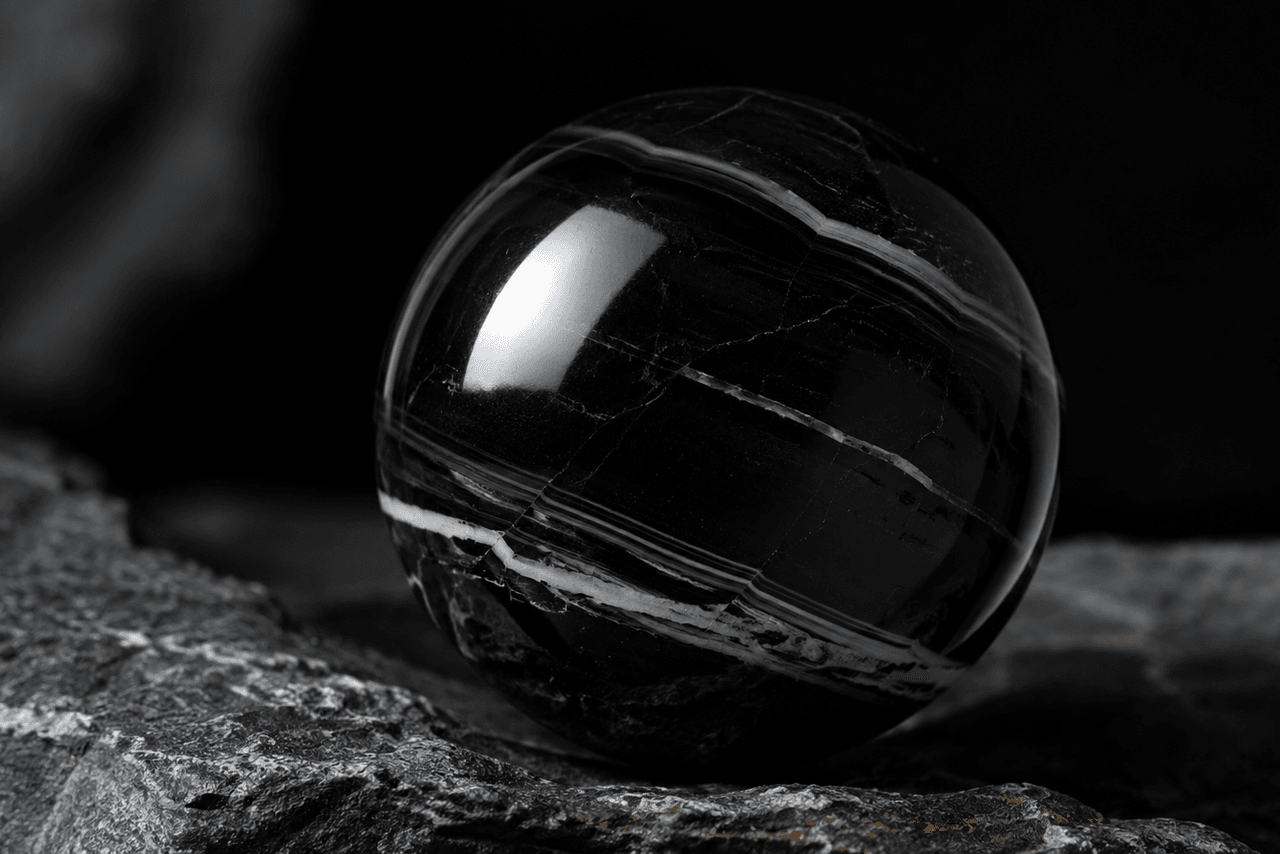
Onyx — Talisman Stone: Meaning, Properties and Who It Suits
Onyx as a talisman stone: the origin of banded black chalcedony, which zodiac sign it suits, the legend of Venus's nails, and how to spot a fake.
Meaning and origin of the stone
Onyx is a black opaque variety of chalcedony, often showing thin white bands inside (a fully solid black stone on the market is more often agate additionally dyed for an even tone). Like agate, onyx forms inside cavities in volcanic rock through layers of silica, differing from its relative mainly in color and pattern uniformity.
The name comes from the Greek onyx, "fingernail." According to ancient myth, Cupid trimmed sleeping Venus's nails with an arrow, and the clippings that fell to earth were turned to stone by the gods, unwilling to let any part of the goddess decay — which is how onyx, with its characteristic banding resembling the structure of a nail, is said to have appeared. In Ancient Rome the stone was one of the most common materials for seals and cameos.
Which zodiac sign it suits
Onyx is traditionally tied to Capricorn — a sign whose strength lies in patience, self-discipline and the ability to move methodically toward a distant goal. The stone is said to strengthen exactly these qualities, helping avoid wasted energy and keep focus in long-term projects.
Onyx's dense, "impenetrable" character resonates well with Capricorn's reserve — the stone is traditionally recommended for anyone who needs to stay composed under stress or in public situations.
Traditional and esoteric properties
Onyx is tied to the idea of inner strength that needs no display — unlike flashier protective stones, onyx is said to work quietly and unnoticed, strengthening its owner's will from the inside rather than deflecting outside attacks. That's exactly why it was traditionally considered a stone of willpower and self-control.
In Ancient Rome and Persia, onyx was worn as a charm for courage before important decisions or legal proceedings — believed to help keep a clear head and resist emotion in tense disputes.
How to spot a fake and care for the stone
Genuine onyx is rarely perfectly uniform in color — close inspection against light often reveals faint bands or slight variations in density. Much of the onyx on the market is actually agate additionally dyed for an even black — that treatment on its own doesn't make the stone fake, but it's worth asking a seller whether you're getting natural onyx or dyed agate.
The stone's hardness is 6.5–7 on the Mohs scale; it holds up well to water and everyday handling, but like other chalcedonies it's sensitive to prolonged direct sun, which can fade artificial dye.
Onyx belongs to the chalcedony family alongside agate, and shares its zodiac sign with garnet. All 28 talisman stones are gathered on the talismans hub.
Suits these zodiac signs
FAQ
This material was prepared by the Elunis editorial team: calculations via Astronomy Engine (based on the VSOP87 and NOVAS models, verified against JPL Horizons data), interpretations based on verified sources. How we prepare our articles