Emerald — Talisman Stone: Meaning, Properties and Who It Suits
Emerald as a talisman stone: the origin of green beryl, which zodiac signs it suits, the legend of Cleopatra, and how to tell it from an imitation.
Meaning and origin of the stone
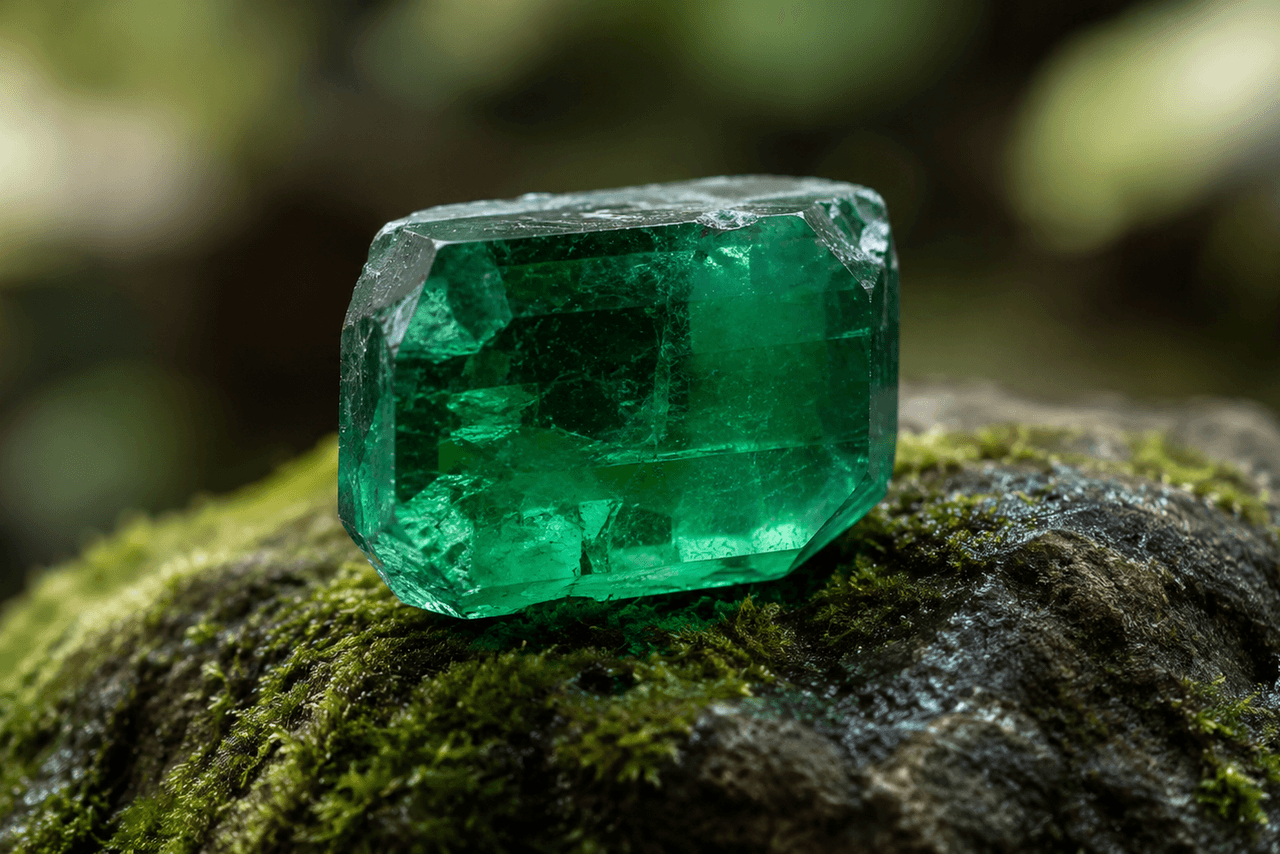
Emerald is a green variety of beryl, the same mineral as aquamarine. Traces of chromium and vanadium in its crystal lattice give it that deep green color — and it's exactly those trace elements that make emerald one of the few beryls with a truly rich, "juicy" hue.
The name comes from the Greek smaragdos, a general term for green gemstones in antiquity. Egypt's emerald mines in the desert near the Red Sea were worked as far back as two thousand years BC, and Queen Cleopatra, according to contemporaries, had a particular weakness for the stone, using it to decorate palace interiors and her own attire.
Which zodiac signs it suits
Emerald is traditionally tied to Taurus and Cancer — signs for whom stability, home and strong emotional bonds matter especially. For Taurus it's said to reinforce material well-being and appreciation for what one already has; for Cancer it strengthens care for family and a sense of safety within one's own home.
Both signs share a pull toward permanence, and emerald has traditionally symbolized exactly that kind of reliable, slowly-growing prosperity, in contrast to fast and risky change.
Traditional and esoteric properties
Emerald has long carried the idea of rebirth and hope — its evergreen color was symbolically tied to spring and nature's renewal. In the Middle Ages, people believed emerald could reveal poison in a drink (supposedly changing color in its presence) and protect its owner's eyesight — it was often worn as an amulet for the eyes.
Emerald is also credited with strengthening loyalty in relationships and drawing sincere, mutual love — which is exactly why it was traditionally given as a sign of serious, long-term intent.
How to spot a fake and care for the stone
Genuine emerald almost always shows inclusions visible to the naked eye — jewelers jokingly call them the jardin, "garden," because they resemble tangled plant fibers. A perfectly flawless emerald with no inclusions at all is a rare thing and worth a second look: it's more likely a synthetic stone or a good imitation.
Emerald's hardness is 7.5–8 on the Mohs scale, but the abundance of internal fractures makes it fairly brittle — easy to chip with a sharp knock, so take emerald jewelry off before physical work or sports.
Emerald belongs to the beryl family alongside aquamarine, and shares its zodiac sign with malachite. All 28 talisman stones are gathered on the talismans hub.
FAQ
This material was prepared by the Elunis editorial team: calculations via Astronomy Engine (based on the VSOP87 and NOVAS models, verified against JPL Horizons data), interpretations based on verified sources. How we prepare our articles