Diamond — Talisman Stone: Meaning, Properties and Who It Suits
Diamond as a talisman stone: the origin of Earth's hardest mineral, which zodiac sign it suits, its symbolism of strength and clarity, and how to spot a fake.
Meaning and origin of the stone
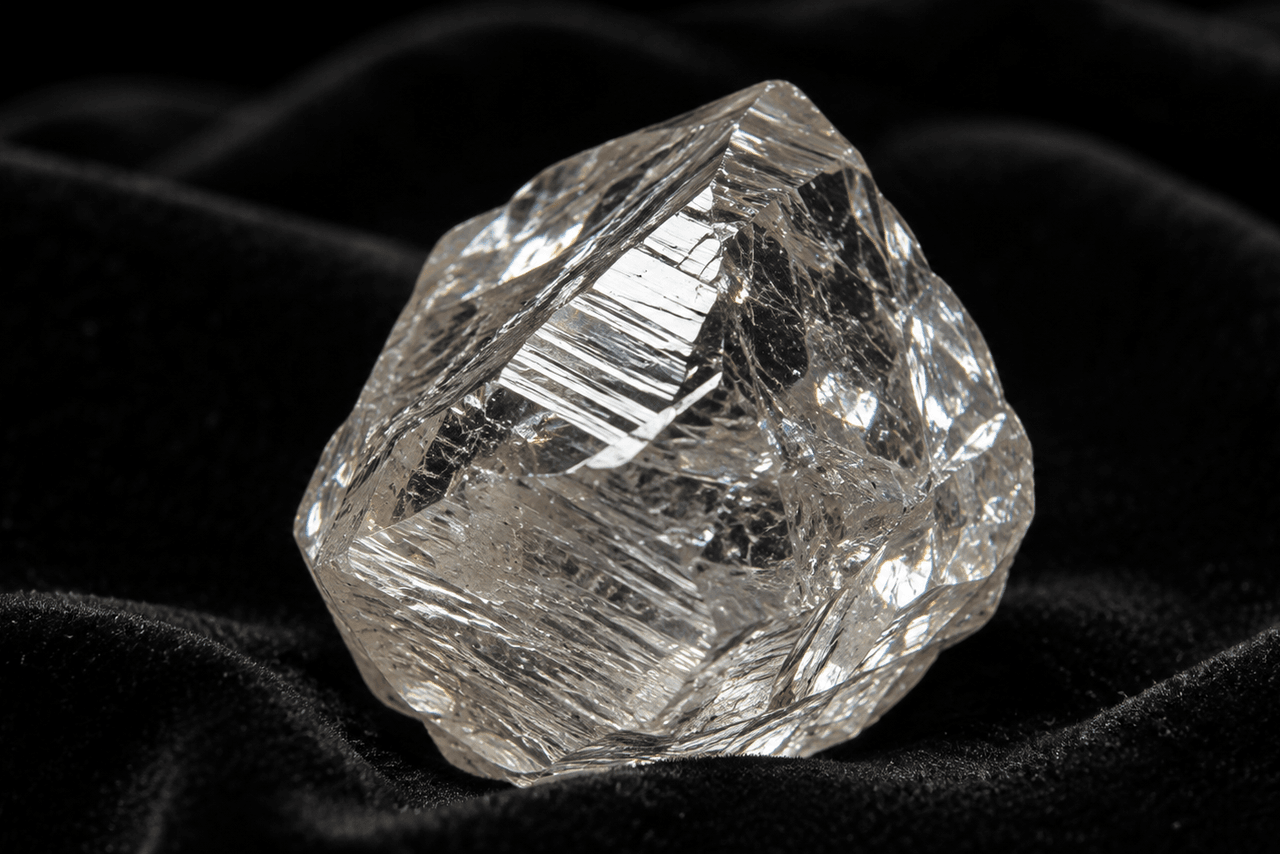
Diamond is a crystalline form of pure carbon and the hardest natural mineral on Earth — a full 10 out of 10 on the Mohs scale. It forms 150–200 km deep in the Earth's mantle under enormous pressure and heat, then reaches the surface through rare volcanic conduits called kimberlite pipes, named after the town of Kimberley in South Africa.
A cut diamond is what most people call a "brilliant" — it's the cut itself, refined by jewelers of the modern era, that unlocks the play of light the stone is prized for today. The tradition of giving a diamond as an engagement gift, despite feeling ancient, actually only took shape in the 15th century at the Austrian court.
Which zodiac sign it suits
Diamond is traditionally tied to Leo — a fire sign ruled by the Sun, whose energy naturally resonates with the stone's concentrated, almost unbearably bright intensity. It's said to strengthen Leo's natural will and help the sign stay focused on big goals instead of getting scattered on small ones.
Other signs aren't barred from wearing it, but tradition urges caution: diamond's concentrated energy can sharpen traits that are already pronounced, so it's more often recommended for people with an already-settled inner footing.
Traditional and esoteric properties
Diamond has long been tied to the idea of invincibility — its very name comes from the Greek adamas, "unconquerable." Across cultures it was worn as protection against enemies and illness, and warriors carried it into battle as a symbol that their spirit was as unbreakable as the stone.
Beyond protection, diamond is credited with amplifying whatever energy surrounds it — its own and that of neighboring stones in a piece of jewelry, which is why it's often placed at the center of a composition. It's also traditionally linked to clarity of thought and decisiveness at turning points in life.
How to spot a fake and care for the stone
The classic test for a genuine diamond is thermal conductivity: a real stone pulls heat away instantly and stays cool to the touch far longer than cubic zirconia or other imitations (professional testers rely on exactly this). A genuine diamond also scratches glass rather than the other way around, and won't fog when you breathe on it — imitations typically fog for a couple of seconds.
Despite its hardness, diamond can chip along a cleavage plane from a sharp knock, so store diamond jewelry separately from other stones — it can otherwise scratch softer neighbors.
Diamond traditionally pairs with Leo's other stones, ruby and pyrope garnet. All 28 talisman stones are gathered on the talismans hub.
Favorece a estos signos del zodíaco
Preguntas frecuentes
Este material fue preparado por la redacción de Elunis: los cálculos se hacen con Astronomy Engine (basado en los modelos VSOP87 y NOVAS, verificado con datos de JPL Horizons), las interpretaciones se basan en fuentes verificadas. Cómo preparamos nuestros artículos